




How Business Check Verification Readiness Helps Protect Payroll, Materials, and Active Job Schedules

📌 Key Takeaways
The author recommends checking business details early and keeping operating plans flexible until the check transaction is complete.
- Prepare Before Traveling: Review the check, organize business records, and identify unclear details before anyone visits the provider.
- Confirm Provider Rules: Identification, documents, authorization, fees, limits, and endorsement rules can vary, so confirm requirements directly.
- Do Not Assume Approval: Preparation can reduce avoidable questions, but the provider still controls requirements and the final decision.
- Keep Plans Flexible: Payroll, materials, and job schedules should not depend only on funds from an unfinished transaction.
- Resolve Questions Early: When details look unclear, the author recommends contacting the provider or issuing party before traveling.
Preparation reduces friction, but it never guarantees funds.
Contractors and trade businesses will reduce avoidable disruption by applying these readiness steps to the practical guidance that follows.
~ ~ ~ ~ ~ ~ ~ ~ ~ ~ ~ ~ ~ ~ ~ ~ ~ ~
A contractor working in the Fredericksburg area may receive a business check during a week that already involves coordinating crew payroll, confirming a materials order, and keeping two active jobs on schedule. If an avoidable verification question surfaces only after someone arrives at the provider, the problem extends beyond paperwork: it can add uncertainty to obligations that are already in motion.
Proper preparation does not guarantee that a provider will cash a check or make funds available on any particular timeline. The practical goal is narrower and more achievable. It is to reduce the preventable questions that could have been identified before the trip. By the end of this guide, you will know what to review on the check itself, what business information to organize, which questions to confirm with the provider, and what not to assume about the transaction outcome.
What Business Check Verification Readiness Actually Means
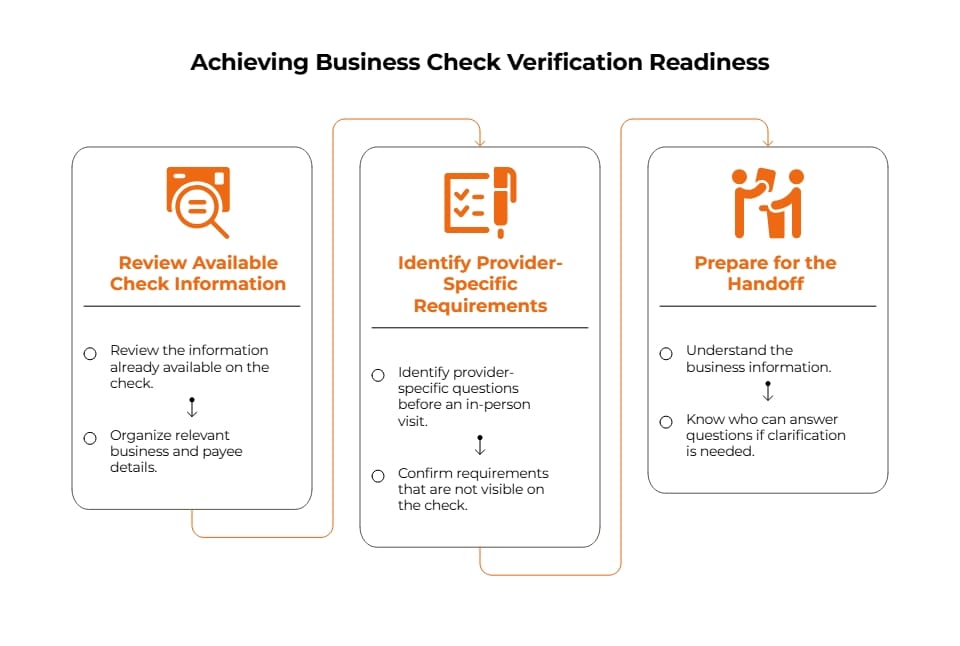
Verification readiness means reviewing the information the information already available on the check, organized relevant business and payee details, and identified provider-specific questions before an in-person visit.
That distinction matters because readiness is not the same as approval. The business can control whether its own information is organized. The provider controls its own requirements and final decision.
While readiness reduces avoidable uncertainty, a provider may still request additional documentation or apply unanticipated requirements. Mixing up your internal preparation with the provider’s specific rules is a common source of preventable friction.
Even when a check appears fine at first glance, preparation still matters. The check itself is only one part of the handoff. The person presenting it may still need to understand the business information, know who can answer questions if clarification is needed, and confirm requirements that are not visible on the check.
Review the Check and Business Details Before You Leave
Before anyone travels, the person responsible for the transaction should review the check and the surrounding business information with fresh eyes. The goal is to surface obvious questions while there is still time to resolve them.
On the check itself, review:
Payee or business name — Does the name shown match how the business is formally identified? Minor inconsistencies between a trade name and a legal entity name can create questions at the provider. Issuer information — Is the issuing party’s name and any contact or bank information legible and complete? Amount — Is the written amount consistent with the numeric amount? Date — Is the check dated, and does the date raise any obvious concerns (such as a post-dated check)? Missing or unclear details — Is anything blank, smudged, incomplete, or visually inconsistent?
Beyond the check, organize the business information connected to the payee. Know who the business entity is, how the payee name relates to the business, and which internal records (such as the invoice, contract, or purchase order that generated the payment) are already accessible. Identify who internally owns the transaction and who can answer questions if the provider needs clarification.
Internal ownership is especially important when administrative work is divided among several people. An owner may receive the payment, a bookkeeper may record it, and an office manager may be the person assigned to visit the provider. Before that handoff occurs, everyone involved should know who can answer a business-related question if one arises.
Do not alter, rewrite, or correct any information on the check based on general advice. If something looks wrong, that is a question for the provider or the issuing party, not a correction to make independently.
Organize Verification Information, Then Confirm Provider-Specific Requirements
A business can organize its own records without knowing exactly what a specific provider will ask for. Gathering relevant identification, business documentation, and internal contact information before the trip is useful regardless of the provider’s particular process.
What a business cannot do is assume that general preparation automatically satisfies every provider’s requirements. Exact identification types, business documentation, endorsement procedures, authorization for someone other than the business principal, fee structures, check-size limits, and processing procedures can all vary. Treating a general readiness checklist as though it were a provider’s official requirement list is a common and avoidable mistake. Use general preparation to organize the transaction, but confirm exact documentation and procedures with the specific provider.
The following table separates what the business can prepare independently from what should be confirmed directly:
| General Readiness (Business Controls) | Confirm With Provider |
|---|---|
| Review payee/business name on the check | Exact identification requirements |
| Review amount, date, and issuer information | Exact business documentation needed. Commonly requested business documents include your EIN assignment letter from the IRS, Articles of Organization or Incorporation, and a valid local business license |
| Organize relevant business records | Authorization requirements if someone other than the owner presents the check |
| Identify unclear details before leaving | Endorsement procedure |
| Prepare a list of provider questions | Fees, limits, or other provider-specific terms |
Turn unknowns into questions. For example:
- What identification is required?
- What business documentation is required?
- Is additional authorization needed for the person presenting the check?
- Are there provider-specific limits, fees, endorsement procedures, or other requirements to confirm?
If an office manager is assigned to handle the transaction, she may have the check and the company’s internal records organized, but she does not know whether the provider requires a specific form of authorization for someone other than the business owner. If she assumes her employer’s verbal instruction is sufficient and discovers otherwise at the counter, the trip may not accomplish what was planned. Resolving that question before traveling is exactly the kind of friction that readiness can prevent.
Similarly, do not assume that one provider’s process applies everywhere. A requirement that was straightforward at one location may work differently at another. Each provider’s identification, documentation, authorization, endorsement, fee, and limit requirements should be confirmed independently.
For businesses exploring business check cashing providers, confirming these details in advance is especially practical when the transaction intersects with time-sensitive operating obligations.
Build Verification Readiness Into Payroll, Materials, and Job Planning
For a small contractor or trade business, an incoming business check rarely exists in isolation. It may connect to the same week’s payroll cycle, a materials purchase for an active project, or an administrative task that affects scheduling. That intersection is what makes verification readiness an operating concern rather than just a financial errand.
Payroll planning. When a business check is expected to support an upcoming payroll obligation, preparation can reduce the administrative uncertainty surrounding the transaction. Avoid building a payroll timeline solely around an uncompleted transaction. Where possible, maintain enough operating flexibility that a delayed or incomplete visit does not immediately create a payroll problem. If payroll planning depends on an incoming payment, distinguish between money the business already controls and a transaction that has not yet been completed.
Materials purchasing. A contractor coordinating a materials order alongside a business-check transaction may be tempted to treat the check proceeds as confirmed purchasing power. Until the transaction is actually completed, that assumption carries risk. Preparation makes the process more orderly, but it does not convert an unfinished transaction into available funds.
Active job schedules. Administrative readiness may remove one source of disruption from a busy operating week. It cannot secure project timelines. If a check transaction is important to near-term scheduling, build a reasonable buffer so that a single administrative dependency does not cascade into a job-site problem.
Decide who will update the owner, bookkeeper, office manager, or other responsible person if the transaction remains unresolved. Identify which near-term decisions should not depend solely on funds that have not yet become available. Contingency planning does not require assuming that something will go wrong. It means knowing what the business will do if the timing remains uncertain.
If a Fredericksburg contractor receives a customer-issued business check on Monday while simultaneously finalizing a materials order for Wednesday delivery and processing end-of-week payroll. Rather than assuming the check will create funds at a specific time, the contractor reviews the check details, organizes business information, confirms provider questions in advance, and keeps payroll and purchasing plans flexible enough to absorb a short delay. That is verification readiness applied as an operating discipline.
One additional point worth noting: a provider’s website may use language emphasizing speed, immediate access, or high limits. That marketing language describes the provider’s general service positioning. It is not a confirmed outcome for any individual transaction. Readiness means preparing thoroughly and keeping expectations grounded in confirmed details rather than promotional framing.
Before You Travel: Business Check Verification Readiness Checklist
Use this checklist as a pre-trip readiness review, not as a universal list of provider-required documents. Items in the “provider questions” category should be confirmed directly with the provider before traveling when any detail is uncertain.
Check details reviewed
- Payee/business name matches how the business is formally identified
- Issuer information is legible and complete
- Amount (written and numeric) is consistent
- Date is present and does not raise obvious concerns
- Nothing appears blank, incomplete, or unclear
Business information organized
- Information identifying the business/payee is accessible
- Relevant internal records (invoice, contract, purchase order) are available
- Name and contact details of the person responsible for the transaction are confirmed
Provider questions identified
- What identification is required?
- What business documentation is required?
- Is additional authorization needed for the person presenting the check?
- Are there provider-specific limits, fees, endorsement procedures, or other requirements to confirm?
Internal handoff confirmed
- Who is going to the provider?
- Who can answer business-related questions if the provider needs clarification?
- Who should be contacted if timing or requirements change?
Operational assumptions reviewed
- Funds and timing are not treated as guaranteed until the transaction is complete
- No critical obligation is scheduled solely around an unconfirmed transaction outcome
- Internal action is decided for the scenario where timing remains uncertain
If Something Is Unclear, Resolve the Question Before the Trip
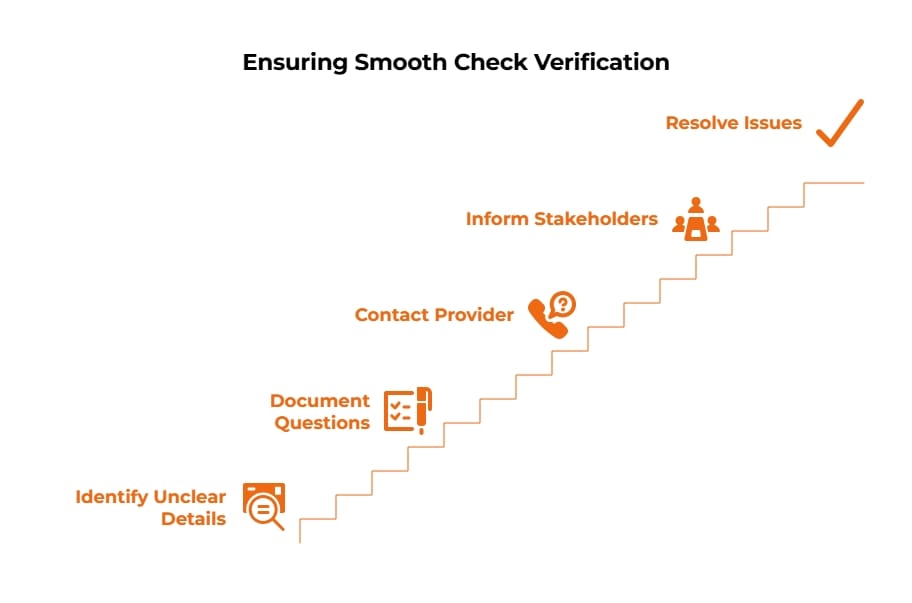
When a detail on the check, a business-information question, or a provider requirement is unclear, the safest step is to resolve the question before leaving. Guessing about acceptance or assuming an unclear detail will be overlooked at the counter is how preventable friction becomes an actual problem.
For instance, a contractor reviewing a business check might notice that a business-related detail, such as the payee name or an issuer reference, does not look quite as expected. The instinct may be to correct the discrepancy or assume the provider will overlook it. Neither response is reliable. The practical step is to write down the specific question and confirm it with the provider or the issuing party before traveling.
Contact the provider using their current official information, or consult the provider’s published resources where available. If the business is considering a visit to the DNV Cheques Fredericksburg location, its Fredericksburg location page provides a relevant local resource for checking current information or contacting them directly. Contacting a provider in advance does not guarantee acceptance, but it can help you arrive with better information.
Keep internal stakeholders informed when timing becomes uncertain. The person coordinating payroll, materials, or job scheduling should know when a transaction dependency is unresolved rather than learning about it after a deadline has passed.
Frequently Asked Questions
What should I review before taking a business check to a provider?
Review the information on the check itself (payee name, issuer details, amount, date, and anything that appears unclear), organize the relevant business and payee information, identify who is responsible for the transaction, and write down any provider-specific questions that need confirmation before you travel.
Do all check-cashing providers require the same business documents?
No. Exact identification, business documentation, authorization procedures, endorsement requirements, fees, limits, and verification steps can vary by provider. Do not assume that one provider’s process applies to another. Confirm the specific requirements with the provider you plan to visit.
Can verification readiness guarantee that payroll or material purchases stay on schedule?
No. Readiness can help reduce avoidable administrative friction and prevent some preventable questions from surfacing at the counter. It cannot guarantee acceptance, fund availability, transaction timing, payroll, materials purchasing, or project continuity. Maintain realistic operating flexibility around any uncompleted transaction.
When should I contact the provider before traveling?
Whenever the check information, business or payee details, authorization situation, documentation requirements, or any other provider-specific question is unclear. Confirming in advance may prevent an unnecessary or incomplete trip. Contacting the provider does not guarantee acceptance, but it can help you arrive better prepared.
What happens if the provider cannot complete the transaction?
The next step depends on the provider and the specific transaction. Do not assume why the transaction could not be completed. Ask the provider what information or next step is available, keep internal stakeholders informed, and continue treating the timing and funds as uncertain until the issue is resolved.
Moving Forward With Realistic Preparation
Good verification readiness cannot determine the provider’s decision. What it can do is reduce the preventable uncertainty that turns a routine administrative task into an unplanned disruption during an already full operating week. The checklist above gives you a structured way to review what you have, identify what you need to confirm, and keep your operational planning realistic.
Review the checklist before your next business-check transaction. Confirm provider-specific questions before traveling. Keep payroll, materials, and scheduling assumptions flexible until the transaction is actually complete.
If you are looking for a provider that offers business check cashing, DNV Cheques has locations throughout Northern Virginia. Encontrar una Ubicación to explore your options.
Disclaimer: This article is for general informational purposes only and does not constitute financial, investment, tax, accounting, legal, or insurance advice. Readers should consult a qualified professional before making decisions based on their circumstances.
Our Editorial Process:
Every piece is researched, written, and reviewed by our Insights Team to ensure accuracy, clarity, and practical value for the communities we serve.
About the DNV Cheques Insights Team:
The DNV Cheques Insights Team creates clear, helpful guides for our customers. While our content is thoroughly reviewed for accuracy, it is for informational purposes and should not replace direct confirmation with your local branch.