




Stop Guessing About High-Value Checks: A Fredericksburg Business Check Readiness Guide

📌 Key Takeaways
High-value business checks require preparation because service availability does not guarantee acceptance, fees, or immediate access to funds.
- Separate Facts From Questions: Confirm documented branch services, then identify check details that still need a direct answer.
- Call Before Traveling: The author recommends confirming the check amount, type, timing, fees, and current branch hours before visiting.
- Prepare Business Records: Typical documents may include photo identification, business registration, tax identification, licensing, and proof of presenter authority.
- Expect Transaction Review: The check amount, issuer, type, presenter authority, and customer history may affect the review process.
- Plan Around Possible Delays: Clear expectations can help protect payroll, material purchases, equipment rentals, and scheduled work from preventable disruption.
Preparation turns payment uncertainty into a workable plan.
Fredericksburg contractors and business owners can reduce wasted time by using the readiness questions and branch guidance that follows below.
~ ~ ~ ~ ~ ~ ~ ~ ~ ~ ~ ~ ~ ~ ~ ~ ~ ~
The phone buzzes again.
At 7:15 a.m., a small Fredericksburg office is already loud with crew texts and supplier questions. On the desk sits a customer check large enough to cover this week’s material run, two days of payroll, and an equipment rental that starts tomorrow. The check is real. The funds are not available yet.
You know the money is there on paper. You also know that walking into a check cashing location without understanding what the transaction might involve could cost you half a workday you cannot spare. Risk controls are the review steps a check casher uses to verify a high-value business check before releasing funds. They function like an inspection lane a payment passes through before entering the business workflow. When the relevant factors are clear, an owner can approach the transaction with better expectations instead of relying on speed claims alone.
This guide separates what a provider documents on its service pages from the transaction-specific variables that may shape your experience, and it identifies the questions worth confirming before you commit driving time or depend on the funds for an obligation that cannot wait.
What Business Check Readiness Means Before a Fredericksburg Visit
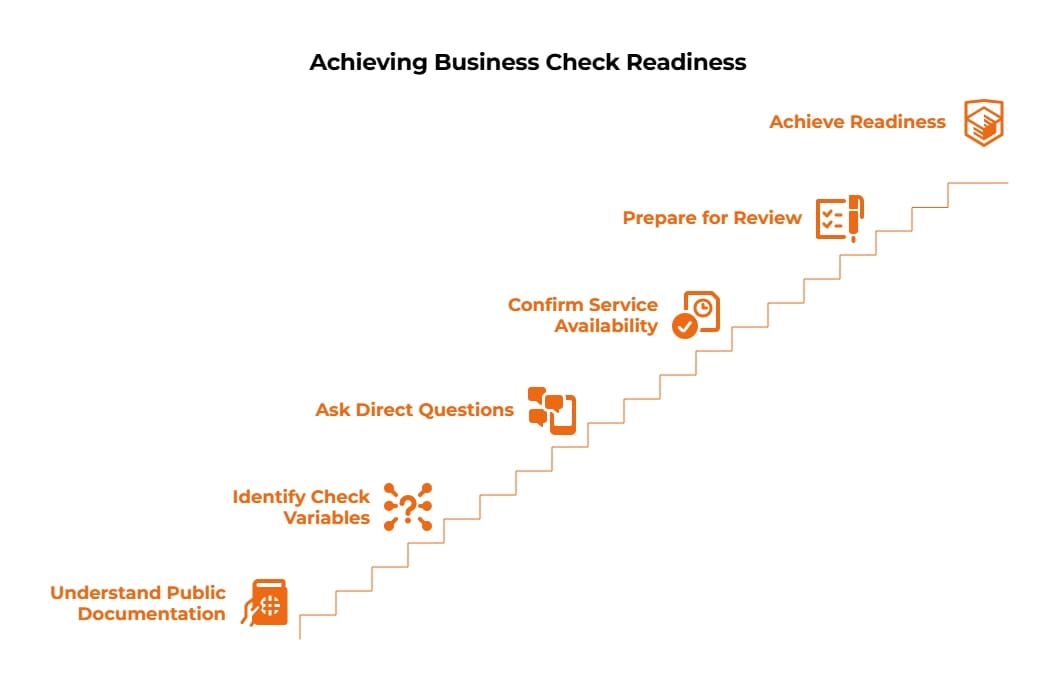
Business check readiness means being prepared, not having a guarantee of acceptance. You are ready when you understand three things: what the provider has publicly documented, which details may vary depending on your specific check, and which questions still need a direct answer before the visit.
Service availability does not guarantee that your specific check will be cashed on the timeline you need. A branch can be open, staffed, and actively serving business customers while still needing to review details specific to your check before releasing funds.
The High-Value Check Readiness Map: Facts, Variables, and Open Questions
The readiness map below organizes the preparation process into three columns. Use it to mark what is already documented, flag what may vary, and list what needs a direct answer before you depend on the funds or drive to the branch.
| Verified service and branch facts | Transaction-dependent variables | Questions to confirm directly |
|---|---|---|
| Documented fact: The provider offers in-person business check cashing. | Transaction-dependent: Check amount may shape what questions need to be asked. This is a preparation framework, not a stated provider rule. | Confirm directly: Does this type and amount of business check fall within the service’s current parameters? |
| Documented service positioning: The service page uses same-day/immediate-access, transparent-fee, and extended-hours positioning. | Transaction-dependent: Issuer and check type may require different information or review. | Confirm directly: Is any additional information needed for this issuer or check type? |
| Documented fact: The service page mentions payroll, contractor, and vendor checks. | Transaction-dependent: Presenter authority and the relationship between the presenter and business may matter. | Confirm directly: What should the person presenting the check bring or confirm about authority? |
| Documented branch fact: The Fredericksburg page provides an address, phone number, hours, and a list of services. | Transaction-dependent: Customer history may affect what questions arise, but the source does not document how. | Confirm directly: What fee and timing information can be confirmed before the visit, and could additional review apply? |
A note on the middle column: These variables represent a preparation framework based on factors that commonly shape check cashing transactions across the industry. They are not a published list of the provider’s decision rules. Use them to organize your own questions, then confirm the answers directly.
The map replaces the guessing mindset with a three-step readiness process:
- Mark what is already documented about the service and branch.
- Identify which transaction details could create an open question for your specific check.
- Confirm unresolved items before relying on the funds or traveling.
Why Branch Availability Does Not Confirm a Specific Check Outcome
Knowing that a Fredericksburg location offers business check cashing is a useful starting point. It tells you the service category exists at that branch.
Think of the difference this way: a hospital emergency room is open and staffed around the clock. That does not tell you how long your specific visit will take or what the treatment plan will involve. The same logic applies to any in-person financial service that involves verification.
How Transaction Readiness Protects the Work Schedule
When you separate known facts from open questions before leaving the office or the jobsite, you reduce the chance of discovering an unresolved issue after you have already invested the travel time. Clear expectations can help protect payroll, purchasing, and scheduled work because the business is not betting its next obligation on an assumption.
Why High-Value Business Check Uncertainty Can Disrupt the Workday
The check exists, but your business cannot yet treat it as available operating cash. Between the paper in your hand and the funds your crew or supplier needs, there may be questions about eligibility, required information, timing, or fees that the check itself does not answer.
How an Uncertain Payment Can Affect Payroll, Materials, and Equipment
Consider the operator who drives 25 minutes to a branch, discovers that an additional piece of information is needed for the specific check, and then has to return to the office before the branch closes at 8 PM. The check did not bounce. Nothing went wrong in the usual sense. But the business lost a window, and that lost window may push a supplier payment past its due date, delay a material pickup, or leave an equipment rental sitting unused for a day.
These are not dramatic scenarios. For contractors and trade-business owners moving between jobsites, suppliers, vehicles, and offices, they are ordinary problems created by ordinary gaps in preparation.
Consider a drywall contractor in the Fredericksburg area who receives a $9,400 check from a general contractor based in Richmond. The check is issued to the business name on the contractor’s Articles of Organization. The contractor assumes the check is straightforward because the amount is not unusual for the scope of work. But the issuer is an out-of-state LLC operating through a Virginia-registered agent, and the check was printed by a third-party payroll service rather than drawn on the general contractor’s own bank. Those details may not matter at all — or they may trigger additional review questions. The point is not that the check is problematic. The point is that the contractor who identifies those details before traveling is better prepared than the one who assumes the check speaks for itself.
Why a Preventable Return Trip Can Become an Operating Problem
Under time pressure, it is natural to assume that having the check is enough. A presenter may overlook an endorsement question, skip confirming whether the business name on the check matches the expected format, or assume that a previous successful transaction covers every future situation. Those assumptions feel reasonable in the moment. They become expensive when they send you back to the branch or push a scheduled payment past its deadline.
Which High-Value Check Details May Need Direct Confirmation
No single preparation checklist can cover every high-value business check transaction. The available service pages do not document internal review triggers, universal document requirements, or decision thresholds. That means the most responsible approach is to understand which categories of detail commonly matter, then confirm how they apply to your situation.
The Impact of Check Amount on Verification
A larger check amount may introduce questions that a smaller amount would not. Because high-value payments carry a naturally higher risk profile, providers typically perform a quick secondary verification to authenticate the check’s origin before providing immediate cash access. This is common across the check cashing industry, not unique to any single provider. The practical step is to confirm whether the specific amount on your check falls within the service’s current parameters and whether any additional review may apply at that level.
Navigating Issuer and Check Types
A payroll check from a well-known regional employer and a one-time vendor payment from an out-of-state company are both business checks. They may not involve the same verification questions. The issuer’s identity, the type of check (payroll, accounts payable, contract payment), and the format of the check itself can all shape what a provider needs to review. Confirm whether the issuer or check type on your specific check raises any questions you should prepare for.
For a closer look at organizing the parties and transaction details connected to a business check, see Who, What, and Where: Business Check Details to Have Ready for Verification.
Presenter Authority and Required Documentation
Whoever brings the check to the branch may need to prove they are authorized to cash it on behalf of the business. Whether the presenter is the owner, a bookkeeper, a finance manager, an operations manager, or another authorized representative, the documentation expected for that role may differ depending on the specific transaction. If someone other than the business owner is presenting the check, confirming what authority documentation may be needed is worth the call.
While specific requirements vary by provider and transaction, you should prepare the following typical documentation before calling:
- Valid government-issued photo ID for the presenter
- A copy of the business registration (such as Articles of Organization or a certificate of formation)
- A letter or document showing the business’s EIN
- A current local business license
- A letter of authorization from the business owner (if the presenter is not the owner)
The Limits of Prior Transaction History
A history of successful transactions with a provider is a positive signal, but it does not lock in the same outcome for a different check. The amount, issuer, check type, or circumstances may differ enough to introduce new questions. As one repeat customer, Guayma P., has shared about the service: “I’ve been cashing my business checks with DNV more than two years.” That kind of reported repeat use reflects a relationship, not a blanket approval for every future check.
Another reviewer, Adel N., described the experience this way: the staff was professional and helpful, and the percentage fees were reasonable. That kind of review suggests a transparent process, but it still reflects an experience under one set of circumstances — not a guarantee that every check type or amount will follow the same path.
Myth and Fact: High Limits Do Not Remove Transaction-Specific Questions
Myth: A high-limit or “no amount too large” statement means every business check can be completed immediately.
Fact: The service page documents immediate-access positioning, but the available sources do not establish a universal review path, acceptance for every check, or a fixed timeline for every transaction.
Speed and verification clarity are not opposites. A provider can process transactions quickly while still reviewing the details that matter for a specific check. Better preparation supports a more predictable experience because the questions that could slow things down have already been identified and addressed.
The biggest readiness risk is not necessarily the amount printed on the check. It is assuming that a general service claim answers every transaction-specific question.
What the Service Page Documents About Business Check Cashing
The business check cashing service page positions the service around several core themes. The page states that the provider offers in-person business check cashing. It uses immediate-access and same-day positioning, describes the service as an alternative to bank holds, and highlights transparent fees, personalized support, and extended hours. The page also mentions payroll, contractor, and vendor checks by name and positions the service as available without a bank account for contractors, freelancers, and small business owners.
These are documented service-page claims. They describe how the service is positioned. They do not serve as a transaction-specific approval, a fee quote, or a guaranteed timeline for any individual check. The distinction between general service positioning and a specific transaction outcome is exactly where your readiness questions begin.
What Should Be Confirmed Before Going to the Fredericksburg Branch
Before committing the travel time, consider confirming these questions directly with the branch:
- Whether the check category and amount can be considered under current service parameters.
- What business and presenter information should be available.
- Whether timing or additional review should be expected.
- What total fee information can be provided before completion.
- Whether the posted branch hours are current for the planned visit.
Items 1 through 4 are questions to ask, not established requirements. The answers may depend on the specific check and circumstances. Item 5 is a logistics check worth making, especially if you are planning a visit during weekend or evening hours.
When a Universal Readiness Rule Breaks Down
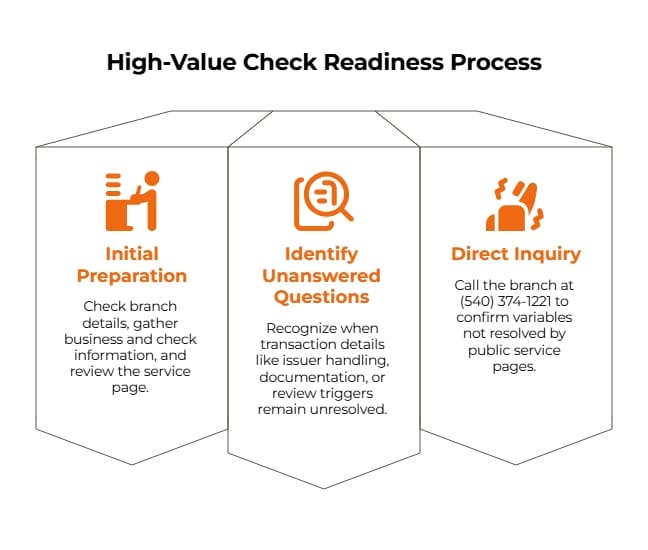
Basic preparation is useful. Checking branch details, gathering available business and check information, and reviewing the service page are all reasonable first steps. That preparation stops being sufficient the moment a transaction detail raises a question the available sources do not answer.
Late in the afternoon, parked outside a supplier, an operator hears equipment and traffic while trying to figure out whether there is enough time to complete an in-person transaction before the branch closes at 8 PM. The check looks straightforward. But is the issuer one the branch handles routinely? Does the presenter need documentation beyond a standard ID? Will the amount trigger any additional review?
Those are not hypothetical obstacles designed to slow you down. They are the kinds of transaction-specific details that the current service pages do not resolve. Because public service pages omit the proprietary algorithms, specific limits, and internal review protocols that dictate check approvals, direct inquiry is the only way to confirm how these variables affect your transaction.
When your preparation hits an unanswered question, call the branch at (540) 374-1221. Three minutes on the phone can prevent a wasted afternoon.
That two-layer process — gather what is already known, then confirm what the available sources do not resolve — keeps preparation practical without overstepping into unsupported claims.
How to Turn High-Value Check Uncertainty Into a Clear Next Step
The readiness sequence you have just worked through follows a consistent logic:
- Document what is known. The service exists, the branch is in Fredericksburg, and the service page describes the general positioning.
- Identify the transaction variables. Amount, issuer, check type, presenter authority, and customer history may each shape the questions that apply to your check.
- Confirm what remains unresolved. Call the branch, use the contact page, or visit with your questions identified in advance.
- Plan the visit with realistic expectations. Arrive with the information you can gather, the questions you need answered, and a timeline that accounts for the possibility that the transaction may involve review.
The check on your desk is a payment, not a plan. The plan starts when you separate what you know from what you still need to confirm — and that sequence is how you get there.
Review DNV Cheques’ business check cashing information to see what the service page documents. Then confirm the Fredericksburg branch details before traveling to make sure the logistics work for your schedule. For additional preparation guidance, the business check cashing requirements guide for Fredericksburg contractors and vendors covers further ground.
General External References
For broader context on the regulatory environment that shapes check processing, the Federal Reserve’s Regulation CC materials explain funds-availability and check-collection rules that apply to depository institutions. This explains why bank check deposits and holds have their own regulatory framework, but it does not dictate a specific provider’s review criteria.
Federal Reserve: Regulation CC, Availability of Funds and Collection of Checks
Virginia’s State Corporation Commission also provides a public resource for checking the current licensing or registration status of regulated financial institutions, including check cashers. This is a general regulatory reference, not a guide to whether a particular check will qualify for a specific transaction.
Virginia SCC: Regulated Financial Institutions and License Verification
Disclaimer: This article provides general information about high-value business check readiness for educational purposes. Individual transactions can vary based on the check and the circumstances surrounding it. Confirm transaction-specific questions directly with DNV Cheques before relying on a particular outcome or traveling to a branch.
Our Editorial Process
This article is grounded in the supplied DNV Cheques website pages, Keyword-URL Map, and the project’s Content Strategy Document. DNV-specific claims are limited to documented evidence. Framework-level guidance is labeled as such, and transaction-specific procedures remain subject to operational confirmation before publication.
By: DNV Cheques Insights Team
The DNV Cheques Insights Team creates practical information about the company’s documented in-person financial services and local branch access. Any operational details that are not present in the supplied source materials should be reviewed by an authorized DNV Cheques subject-matter expert before publication.